The Implications of Artificial Intelligence for Creators and the Role of the Fair Use Doctrine
By: Georgina Michelle
Artificial intelligence (AI) has become an increasingly integral part of life, with many benefits that ease daily tasks.[1] These developments are viewed simultaneously as a leap forward in human innovation and ingenuity by proponents, and as a stifling of creativity by opponents.[2] On one hand, the use of AI tools can lead to greater efficiency, leaving redundant tasks to be completed on autopilot, creating space and allotting time for projects that require greater effort.[3] On the other hand, the rise of AI unleashes a host of ethical and moral dilemmas, issues regarding personal privacy, and various forms of cybercrime.[4] Among these ethical issues grows the increasing concern for protecting intellectual property, with opponents calling for the prevention of content farming by AI in order to optimize its operation.[5]
To develop generative AI, the AI models st first be trained using large volumes of data, which can be mined from the internet, to build what is known as a foundational model.[6] This helps the AI to be able to generate responses to various prompts, based on the knowledge that has been acquired through this system of input.[7] A problem arises when this effort to optimize the AI’s performance and operation is done without consent of the original human authors of the work used to train the AI, completely disregarding the hard work that is done by other people.[8] In Anderson v. Stability Al Ltd., various artists alleged that Stability used the artists’ work to train its AI software in order to produce images in a replicated style.[9] Artists find their craft being encroached upon as AI models are able to create work based on the portfolios of human creators, often without the artists’ consent.
This controversy continues to affect not only those who work in the creative realm, but also other sectors such as legal research platforms. For instance, Thomson Reuters has faced its content being used by startup tech companies producing AI.[10] The doctrine of fair use remains a common defense used by AI-producing companies.[11] Fair use essentially means that other entities may use the work even if it is copyrighted, if the use falls within certain protected categories, such as education and research.[12] In Concord Music Group, Inc. v. Anthropic PBC, the boundaries of fair use were tested as music publishers alleged that an AI software company, Anthropic PBC, was training its generative AI based on the publishers’ copyrighted lyrics.[13] Interestingly, in that case, the court stated that the music publishers did not prove that the AI’s use of the copyrighted works affected or diminished the value of the works.[14]
Anthropic PBC found itself in another legal skirmish, this time involving authors who disputed the use of their work in the development of generative AI. In Bartz v. Anthropic PBC, three authors sued Anthropic for using their works for the firm’s central library and using copies of those works to train its large language models (LLMs).[15] Here, the court ruled that training generative AI was transformative, a term used to mean that a new work has been created out of an original copyrighted work by adding something new, which would be a factor in favor of the fair use defense.[16] Concerns were raised by the authors in this case that allowing the LLMs to be trained using their books would cause an “explosion of works competing with their works.”[17] However, this idea was rejected by the court, which reasoned that it would be no different from schoolchildren learning to write well as a result of training and then threatening to creatively or competitively displace existing professional authors.[18] This ruling sets a favorable precedent for AI companies, providing a shield surrounding the use of external data and information to train AI software.
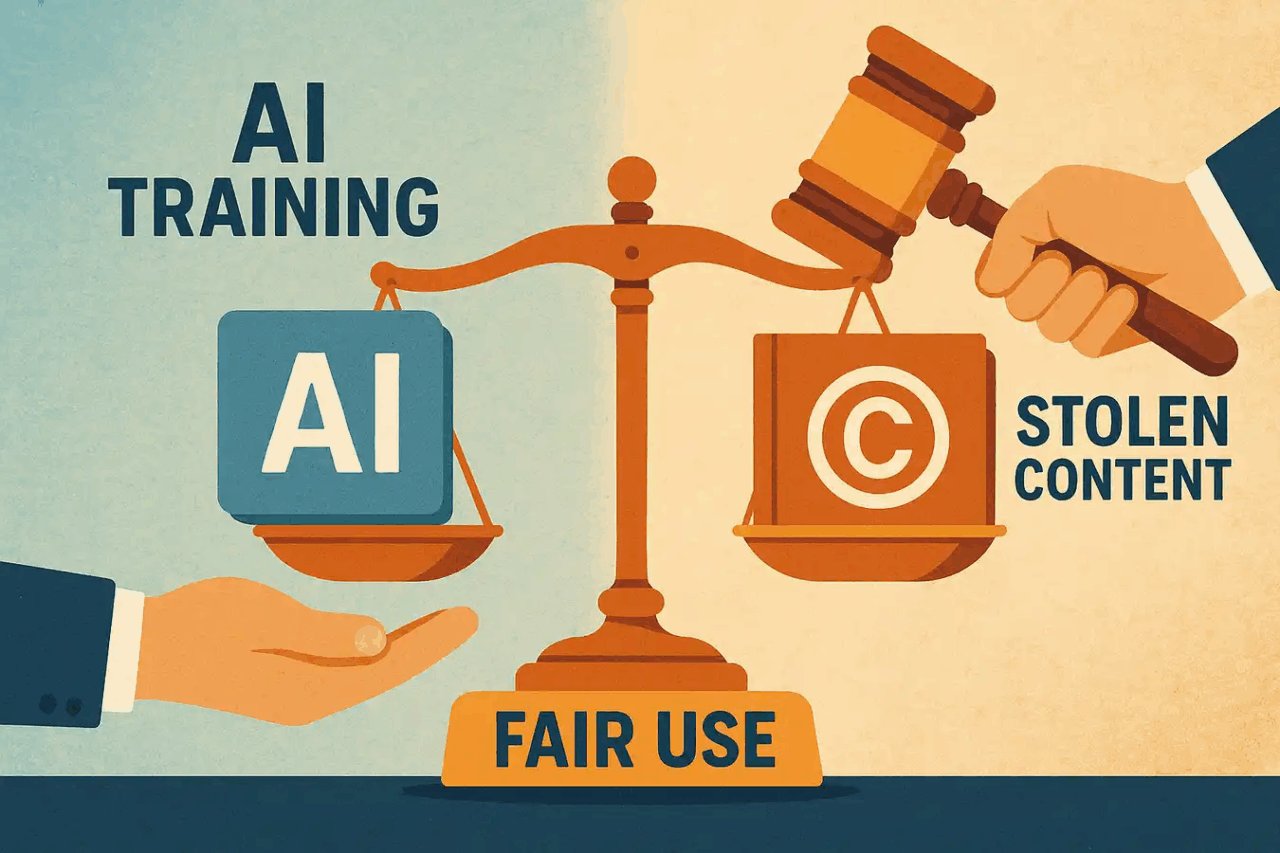
Opponents of this form of developing AI base their disapproval on the argument that by allowing companies to train their generative AI systems using copyrighted content, these companies would gain an unfair advantage, including massive financial gain.[19] By building on human creators’ works, AI systems are able to replicate the style and content of original works, which gives them a competitive advantage in the market.[20] Furthermore, these opponents argue that barring the fair use doctrine would be a huge step forward in protecting the work of creators, as it would push AI companies to seek permission before using copyrighted material.[21]
It is true, AI may have had the original intention of making life easier for the average person and thus, allowing them to have the time to invest in creative pursuits.[22] However, in an ironic twist, it may be that AI could inadvertently lead to a decimation of creativity.[23] After all, why invest time in creating original works if AI can be prompted to create something similar with much less effort?[24] If there is a goal in protecting original, copyrighted work, lines will need to be resolutely drawn in the sand that clearly define what is considered fair use of copyrighted material.[25]
Link to image source:
[1] Cole Stryker & Eda Kavlakoglu, What is AI?, IBM Think (Aug. 9, 2024), https://www.ibm.com/think/topics/artificial-intelligence.
[2] Trey Edgington, Is AI Good or Bad for Society?, University of Phoenix (Oct. 10, 2024), https://www.phoenix.edu/blog/is-ai-good-or-bad-for-society.html.
[3] See id.
[4] See id.
[5] Kate Crawford & Jason Schultz, Generative AI is a Crisis for Copyright Law, Issues in Sci. and Tech. (Jan. 16, 2024), https://issues.org/generative-ai-copyright-law-crawford-schultz/.
[6] Stryker & Kavlakoglu, supra note 1.
[7] See id.
[8] Crawford & Schultz, supra note 5.
[9] Andersen v. Stability Al Ltd., 744 F. Supp. 3d 956, 963 (N.D. Cal. 2024).
[10] Kate Knibbs, Every AI Copyright Lawsuit in the US, Visualized, Wired (Dec. 19, 2024, 1:41 PM), https://www.wired.com/story/ai-copyright-case-tracker/.
[11] See id.
[12] U.S. Copyright Office Fair Use Index, U.S. Copyright Office (Feb. 2025), https://www.copyright.gov/fair-use/.
[13] Concord Music Group, Inc. v. Anthropic PBC, No. 24-CV-03811-EKL, 2025 WL 904333 (N.D. Cal. Mar. 25, 2025).
[14] See id. at 6.
[15] Bartz v. Anthropic PBC, 787 F. Supp. 3d 1007 (N.D. Cal. 2025).
[16] See id.
[17] Id. at 1031-32.
[18] Bartz, 787 F. Supp. 3d at 1031-32.
[19] Matthew Coulter, Aiming for Fairness: An Exploration into Getty Images v. Stability AI and its Importance in the Landscape of Modern Copyright Law, 34 DePaul J. Art, Tech. & Intell. Prop. L. 124, 131 (2024).
[20] See id. at 132.
[21] See id. at 135-36.
[22] Edgington, supra note 2.
[23] See Coulter, supra note 15 p. 141.
[24] See id. at 141.
[25] Crawford & Schultz, supra note 5.
Leave a Reply
You must be logged in to post a comment.