
The first exclusively online law review.

Tag: Artificial Intelligence Page 1 of 2

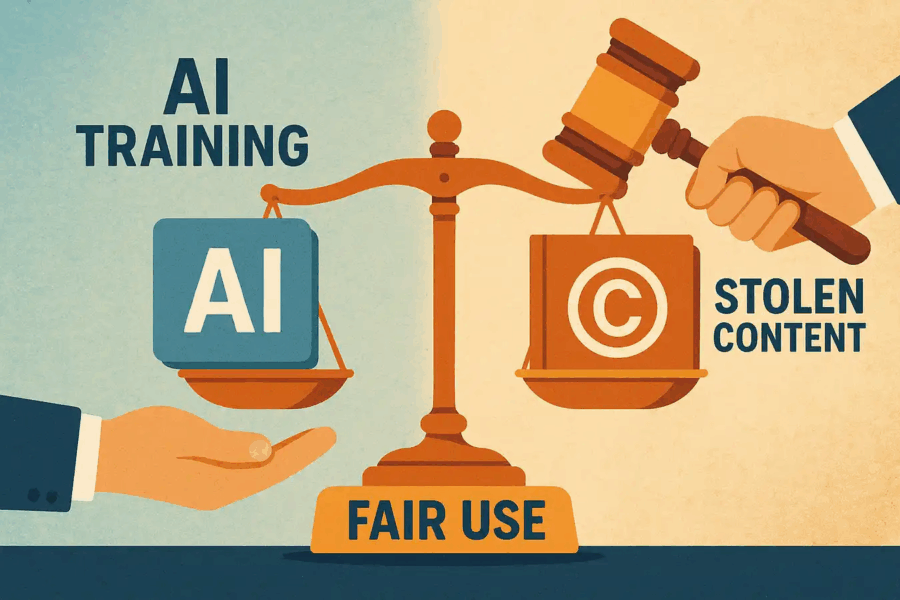
The Implications of Artificial Intelligence for Creators and the Role of the Fair Use Doctrine

The Implications of Artificial Intelligence for Creators and the Role of the Fair Use Doctrine

By: Georgina Michelle

Artificial intelligence (AI) has become an increasingly integral part of life, with many benefits that ease daily tasks.[1] These developments are viewed simultaneously as a leap forward in human innovation and ingenuity by proponents, and as a stifling of creativity by opponents.[2]  On one hand, the use of AI tools can lead to greater efficiency, leaving redundant tasks to be completed on autopilot, creating space and allotting time for projects that require greater effort.[3]  On the other hand, the rise of AI unleashes a host of ethical and moral dilemmas, issues regarding personal privacy, and various forms of cybercrime.[4] Among these ethical issues grows the increasing concern for protecting intellectual property, with opponents calling for the prevention of content farming by AI in order to optimize its operation.[5]

AI In The C-Suite: Rethinking Director Reliance Under DGCL § 141(e) In The Age of Algorithms

AI In The C-Suite: Rethinking Director Reliance Under DGCL § 141(e) In The Age of Algorithms

By: Chelsea Marie Mojica

We now live in an Age of Algorithms where algorithmic machines are seen as “a kind of glue binding the world together through reliable pathways of mathematics and symbolic logic.”[1] With just a push of a button, artificial intelligence (“AI”) can mimic human functions, gather data and make a prediction, and generate various outputs.

Although many believe that modern AI began its development in the mid 1900s[2], AI use has significantly increased within the past few years. Notably, in 2022, a small research laboratory, famously known as OpenAI, released its first version of ChatGPT, an AI chatbot that can answer questions, develop emails, and everything in between.[4] In 2025, OpenAI’s CEO Sam Altman announced that “more than 800 million people use ChatGPT every week.”[5] Professionals are using AI in various ways. Among the many users are UK Judges, who have the ability to use ChatGPT as a supplement to write judgments.[6] Two lawyers, Peter LoDuca and Steven A. Schwartz, “submitted non-existent judicial opinions with fake quotes and citations created by the artificial intelligence tool ChatGPT, then continued to stand by the fake opinions after judicial orders called their existence into question.”[7] As a result, the two attorneys were sanctioned and required to each pay $5,000 to the client they represented.[8]

Virtual Infidelity: Is Cheating with an AI Girlfriend Considered Adultery?

Virtual Infidelity: Is Cheating with an AI Girlfriend Considered Adultery?

By: Carolyn Potts

Her, a film about a man who falls in love with a virtual assistant, was released in 2013.[1] When the movie came out, virtual affairs may have seemed like science fiction, but now, twelve years later, “virtual infidelity” has become a harsh reality for a growing number of couples. For many people, Artificial Intelligence (“AI”) is seen as a tool to answer questions or to manage tasks, but for some, it provides a sense of romantic companionship. Platforms generating AI girlfriends are experiencing a massive growth in popularity, with millions of users.[2] While most of these searches are initiated by young single men, many users engaging in relationships with AI chatbots are married to real life people.[3] The recent rise in AI love affairs begs the question, how do these virtual relationships factor in to divorce cases?

How Would Drones Piloted by A.I. Affect Our Fourth Amendment Rights?

How Would Drones Piloted by A.I. Affect Our Fourth Amendment Rights?

By: Joseph Coyle

In January 2025, drone manufacturer Red Cat announced a partnership with Palladyne AI to integrate Palladyne Pilot AI software into Red Cat’s Black Widow drones.[1] These drones are designed to be able to identify, prioritize, and track targets with little to no human direction.[2] Red Cat first unveiled the Black Widow drone in 2024.[3] These drones are already in use in the United States Military.[4] The Black Widow drone is fitted with a GPS system, camera, electro-optical sensors, infrared sensors, and has a flight time of over forty-five minutes.[5]

Streaming the Unseen: The Case for Transparency in Music Streaming

Streaming the Unseen: The Case for Transparency in Music Streaming

By: Brooke Gerber

We live in a time where artificial intelligence (AI) is the new “It Girl.” From the film industry to photography to literature, AI has become one of the most talked-about forces shaping modern creativity. But has AI evolved to the point where it can break into the Billboard Hot 100? Increasingly, the answer seems to be yes. AI-generated songs are gaining traction around the world, with many listeners not realizing the music they’re streaming was not performed by a human. That lack of transparency raises legal and ethical questions, particularly surrounding the role of streaming platforms in protecting consumers from being misled.

Robo-Lawyers: Is The Legal Profession at Risk?

Robo-Lawyers: Is The Legal Profession at Risk?

By: Coles Owens

Artificial intelligence (“AI”) is increasingly being used in the legal field, and many seem to be asking the same question: Will AI mark the beginning of the end for attorneys as we know them?[1]

On one hand, AI can increase efficiency and improve the quality of work produced[2] while reducing attorneys’ workloads, costs of litigation, and hours.[3] AI tools speed up the processes of recording and analyzing information provided by clients, contract analysis, document summarization, and case research.[4] AI is also being used to inform bail and sentencing decisions by judges.[5] Lawyers being able to complete tasks faster by using AI may drive the price of legal services down, making them more accessible and affordable.[6] This multitude of benefits has led to 79% of law firms surveyed by Barone Defense Firm reporting use of some form of AI technology in their work.[7]

Game Changing Tech and Regulations

Game Changing Technology and Regulations: How AI is Reshaping Online Sports Betting and What the U.S. May Do About It

By: Chelsea Mojica

Since its legalization, online sports betting has made its mark on professional sports.[1] Sports betting is an activity that allows gamblers to predict the outcomes of future sporting events in conjunction with monetary wagers.[2] Bookmakers—teams comprised of sports experts, analysts, and statisticians—set the initial betting odds for the public, relying on complex mathematical calculations, statistical models, and historical data.[3] The lower the probability of an event happening, the bigger the potential monetary reward.[4] When the sporting event begins, the odds may fluctuate, similar to the stock market.[5] However, odds can lack uniformity among sportsbooks, allowing bettors to receive more cash rewards through some sportsbooks than others.[6] Consequently, AI has integrated itself into the betting world in an attempt to expedite and protect an arduous odds-making process.[7]

Artificial Intelligence in the Law Classroom: Good? Bad? Or Maybe Both?

Artificial Intelligence in the Law Classroom: Good? Bad? Or Maybe Both?

By: Nadia Farashahi

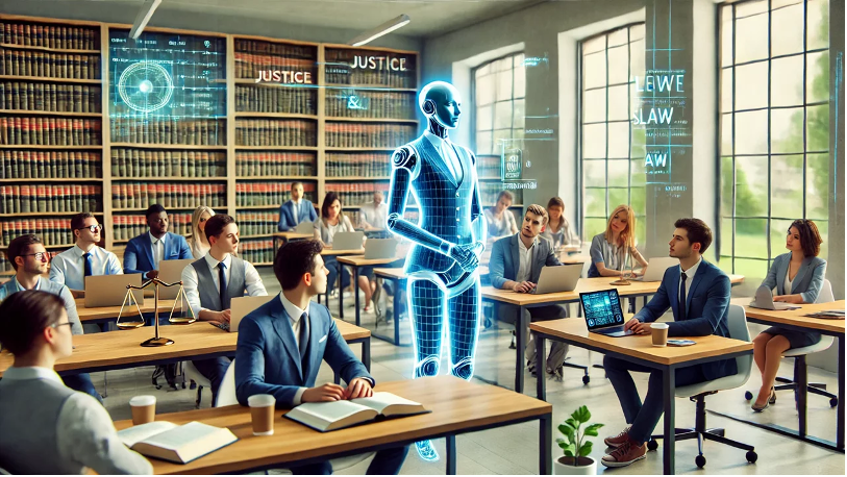
Whether we like it or not, artificial intelligence has taken its place in our society. Law schools are no exception.[1] With the rise in artificial intelligence, law schools are faced with the challenge of adapting to this new technology.

Bloomberg Law’s Spring 2024 Path to Practice survey encompassed data from more than 150 U.S. Law schools.[2] This survey reflected that the status quo is changing: “technological advancements have pushed law schools to address longstanding gaps in tech skill development, specifically by embracing and offering more AI-focused courses.”[3] Faculty respondents were asked whether their law schools “asked or encouraged them” to update their courses to reflect these new technological advancements in the legal field, and more than a third of the respondents said “yes.”[4] The survey also inquired about AI specific courses that are available to law students. Around 40% of respondents indicated that the courses give students “practical experiences using AI for legal work.”[5]

The American Bar Association Task Force on Law and Artificial Intelligence conducted a similar survey.[6] The survey, completed by 29 law school deans or faculty members in 2023 to 2024, showed that AI is steadily establishing a firm presence in the law school classroom. Around 55% of the law school respondents reported that they have classes centered around teaching students about AI, and around 83% reported having curricular opportunities that allowed students to learn to use AI effectively.[7]

AI in Contract Drafting: Transforming Legal Practice

AI in Contract Drafting: Transforming Legal Practice

By: Audrey Zhang Yang

Woman typing on laptop with one organic hand and one robot hand.


Introduction

The legal profession is experiencing an unprecedented transformation driven by the integration of Artificial Intelligence (AI) into various aspects of legal practice. Among these changes, the evolution of contract drafting and management stands as a particularly significant development. As law firms and legal departments navigate the opportunities and challenges presented by evolving legal technologies, understanding how AI is reshaping contract drafting becomes crucial for legal practitioners and law school students. This paper examines the current state of AI in contract drafting, its practical applications, and its implications for the legal profession.

Page 1 of 2

Powered by WordPress & Theme by Anders Norén