The first exclusively online law review.

Tag: Fair Use

The Implications of Artificial Intelligence for Creators and the Role of the Fair Use Doctrine

The Implications of Artificial Intelligence for Creators and the Role of the Fair Use Doctrine

By: Georgina Michelle
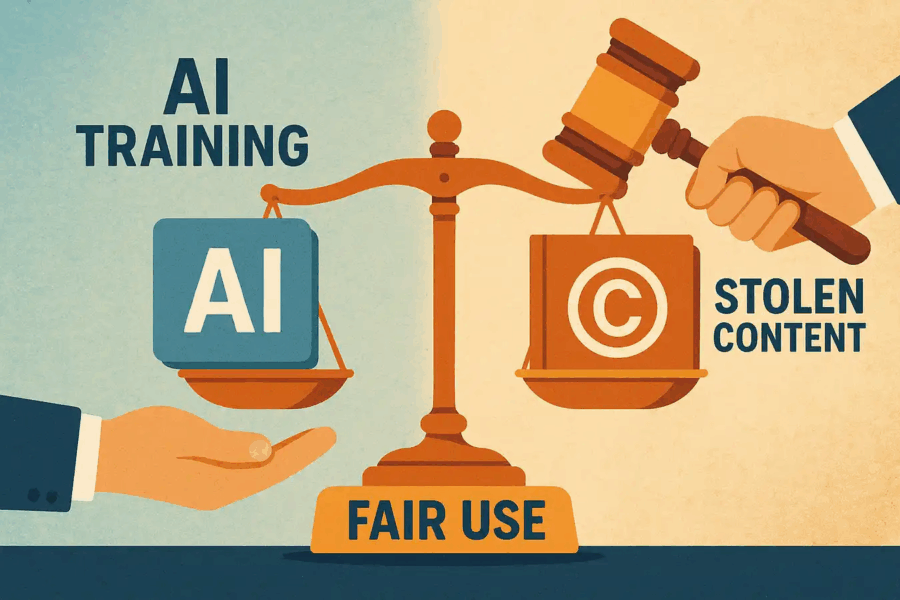
Artificial intelligence (AI) has become an increasingly integral part of life, with many benefits that ease daily tasks.[1] These developments are viewed simultaneously as a leap forward in human innovation and ingenuity by proponents, and as a stifling of creativity by opponents.[2]  On one hand, the use of AI tools can lead to greater efficiency, leaving redundant tasks to be completed on autopilot, creating space and allotting time for projects that require greater effort.[3]  On the other hand, the rise of AI unleashes a host of ethical and moral dilemmas, issues regarding personal privacy, and various forms of cybercrime.[4] Among these ethical issues grows the increasing concern for protecting intellectual property, with opponents calling for the prevention of content farming by AI in order to optimize its operation.[5]

George R.R. Martin Won’t Bend the Knee – Chat GPT, Generative AI, and the Fine Line Between Fair Use and Copyright Infringement

By Perla Khattar[1]


On September 19, 2023, George R.R. Martin and other professional fiction writers filed a class action lawsuit against OpenAI in the United States District Court for the Southern District of New York. The Plaintiffs alleged that at the heart of Large Language Models (LLMs) exists “systematic theft on a mass scale.”[2]  In their complaint, the plaintiffs explained that OpenAI, the maker of the LLM ChatGPT, copied their copyrighted works of fiction without permission and fed the data into LLMs that are carefully programmed to “output human-seeming text responses to users’ prompts and queries.”[3] The authors allege that OpenAI downloaded the manuscripts from pirated eBooks repositories.[4]

Powered by WordPress & Theme by Anders Norén